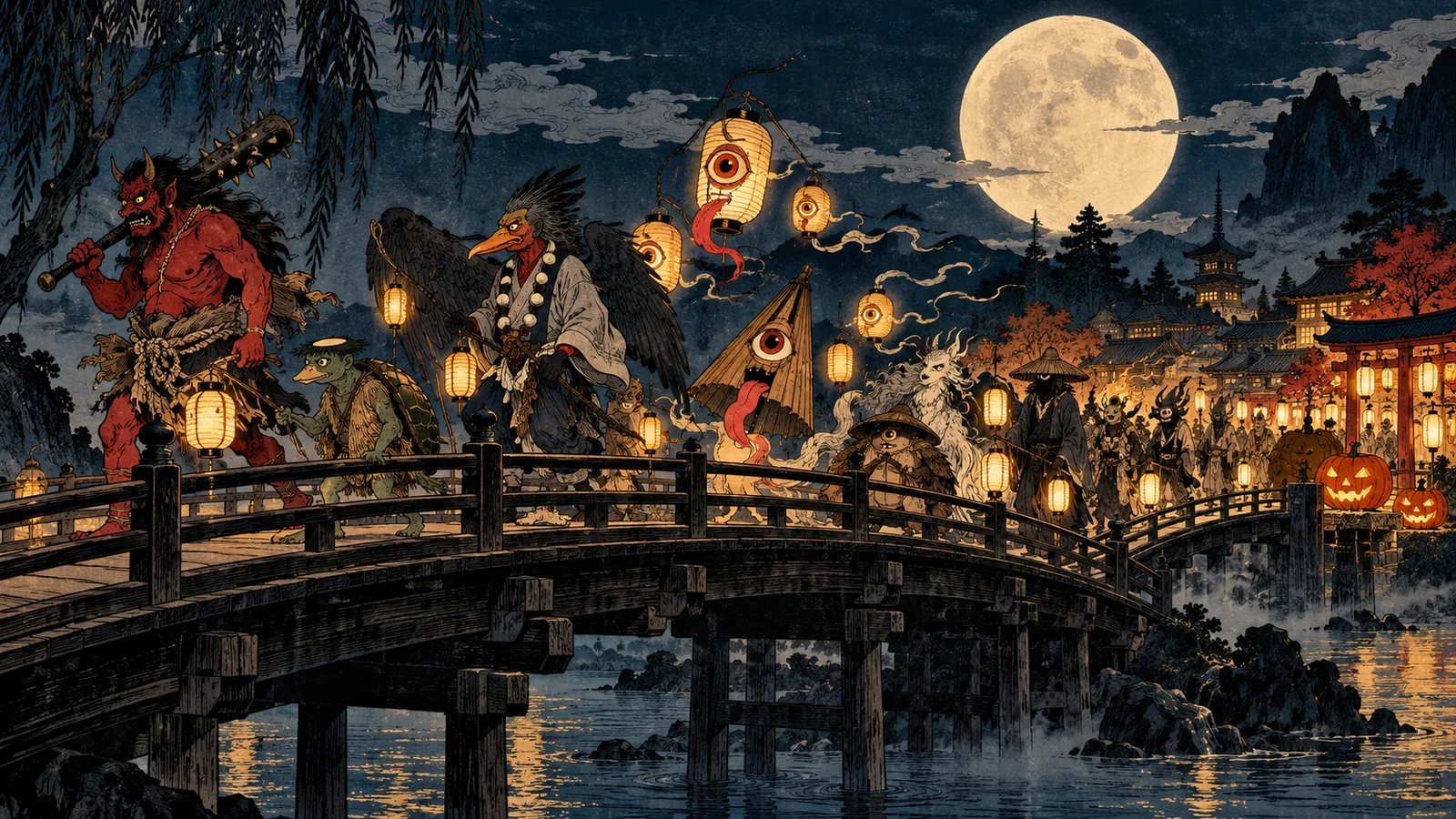
The core answer: While modern Halloween and Japan’s legendary Hyakki Yagyō (Night Parade of One Hundred Demons) both imagine an autumn night when the boundary between the living and the supernatural dissolves, their foundational philosophy is opposite: Halloween originates from disguise and mimicry (ancient Celts dressing as spirits so wandering ghosts would mistake them for kin), whereas the classical Night Parade is rooted in strict avoidance and indoor sanctuary (Heian-era aristocrats locking their doors and chanting protective sutras until dawn to never gaze upon the walking dead).
As late October brings longer shadows across both hemispheres, examining these two traditions reveals how different civilizations interpreted the changing seasons and humanity’s universal unease with the dark.
1. What Is Hyakki Yagyo? The Classical Demon Procession
In classical Japanese folklore, Hyakki Yagyō (百鬼夜行) refers to the terrifying nocturnal march of hundreds of spirits, demons, and transformed objects wandering through town roads.
The Heian Taboo of Night Walking
Mentions of the parade appear as early as the 11th-century Konjaku Monogatarishū and the 13th-century Uji Shūi Monogatari. In the aristocratic capital of Heian-kyō (modern Kyoto), court diviners calculated specific inauspicious dates on the lunar calendar known as Hyakki Yagyō-bi (Parade Days).
On these designated nights, citizens were forbidden from stepping outdoors after dusk. Encountering the demonic vanguard meant instantaneous madness or death, unless one possessed a blessed talisman sewn into their garment or recited the ancient apotropaic charm passed down through courtly families.
The Muromachi Shift: Rise of the Tsukumogami
By the 15th and 16th centuries, the dreaded demonic procession took on an artistic and satirical dimension. The famous Hyakki Yagyō Emaki preserved at Daitoku-ji’s Shinju-an temple portrays not monstrous ogres, but tsukumogami—household tools that achieved sentience after one hundred years of service.
Discarded pestles, tattered straw shoes, broken zithers, tea kettles, and ceremonial umbrellas grew claws, tails, and fangs, parading through the night in chaotic glee before fleeing the rising morning sun.
2. Samhain and Halloween: Turning Toward the Veil
Modern Halloween traces its roots to the ancient Gaelic festival of Samhain (pronounced SOW-in), celebrated by Celtic communities across Ireland, Scotland, and the Isle of Man.
Marking the Dark Half of the Year
Held at the midpoint between the autumn equinox and winter solstice (traditionally sunset on October 31 to sunset on November 1), Samhain marked the conclusion of the harvest and the onset of winter’s dormancy. Celts believed that during this liminal window, the veil separating the physical mortal realm from the Otherworld (Aos Sí) thinned to near transparency.
The Purpose of Costumes (Guising)
Unlike Japanese courtiers who shuttered their residences, ancient Celts actively ventured outside to gather around sacred hilltop bonfires. To navigate a landscape populated by wandering fae, ancestral souls, and mischievous spirits without being harmed or kidnapped, individuals practiced "mumming" or "guising"—donning animal pelts and soot masks to disguise their living identities. Offering food and hospitality (turnip lanterns and cakes) was practiced to appease hungry travelers from the Otherworld.
3. Comparative Overview: East and West
| Dimension | Halloween (Celtic Samhain) | Hyakki Yagyo (Japanese Folklore) |
|---|---|---|
| Primary Cultural Origin | Ancient Gaelic pastoral festival (Ireland/Scotland) | Heian court divination & Onmyōdō traditions |
| Traditional Timing | Fixed solar midpoint: sunset Oct 31 – Nov 1 | Variable lunar calendar taboo dates (Gatano-hi) |
| Nature of the Entities | Ancestor spirits, nature fairies (Aos Sí), puca | Demons (oni), vengeful ghosts, animated tools (tsukumogami) |
| Protective Strategy | Guising (disguise as a monster) & communal bonfires | Confinement (monoimi), locked gates, Buddhist chants |
| Consequence of Contact | Trickery, fairy abduction, or spiritual blessings | Calamity, fatal curse, or severe illness |
| Modern Evolution | Global costumed festival & neighborhood trick-or-treating | Recurring motif in anime, manga, and folklore study |
4. Seasonal Psychology: Why the Autumn Night Demands Stories
Neither tradition arose in a vacuum. Both Samhain and the calendar dates of Hyakki Yagyō coincide with the sudden contraction of sunlight and the sharp drop in evening temperatures.
Before electric illumination, twilight brought an abrupt, disorienting transformation of familiar landscapes. Trees became silhouettes; settling roof beams sounded like footsteps. By giving name, form, and ritual structure to the unknown, human communities translated their dread of winter isolation into narrative art. Whether dressing up as a ghoul in ancient Connacht or painting a broken biwa with grinning teeth in Kyoto, storytelling served as the ultimate shield against the cold.
5. Finding Resonance in Folklore
The creatures of historical bestiaries were rarely evil for its own sake; they reflected human vulnerabilities—carelessness toward belongings, the fear of solitary travel, or unresolved regret.
In Yokaizen, classic Japanese folklore is reimagined as an interactive mirror for modern life. Through authored reactive stories that gently respond to your reading rhythm, the spirits of the bestiary provide a thoughtful companion for late-night reflection, proving that the shadows of autumn still have stories to tell.
Frequently Asked Questions
Q. Is the Japanese Night Parade celebrated as a modern festival like Halloween?
A. Classical Hyakki Yagyō was a mythical taboo rather than an annual public festival. However, in modern Japan, themed events such as Kyoto’s Ichijo Hyakki Yagyo (held in the Taishogun shopping district) feature handmade yokai costume parades celebrating the area’s legendary connection to the folklore.
Q. Why did ancient Japanese people believe tools could become yokai?
A. Under Shinto and animist philosophy, spirits (kami) reside in all natural objects and craftsmanship. The concept of tsukumogami taught that when tools were discarded carelessly after decades of faithful service, their neglected spirits felt sorrow and spite, manifesting as nocturnal tricksters to remind humans to respect their belongings.
Q. Did ancient Celts carve pumpkins for Halloween?
A. No. Pumpkins are indigenous to the Americas. The original Celtic custom used hollowed-out turnips, rutabagas, or large beets carved with grotesque faces and illuminated with coal or tallow candles to ward off malevolent spirits. Irish immigrants brought the tradition to North America in the 19th century, where native pumpkins proved far easier to carve.
Sources
- https://dl.ndl.go.jp/pid/1288339 (National Diet Library, Toriyama Sekien 'Gazu Hyakki Yagyō' 1776)
- https://emuseum.nich.go.jp/detail?langId=en&content_base_id=100320 (e-Museum, Shinju-an 'Hyakki Yagyō Emaki')