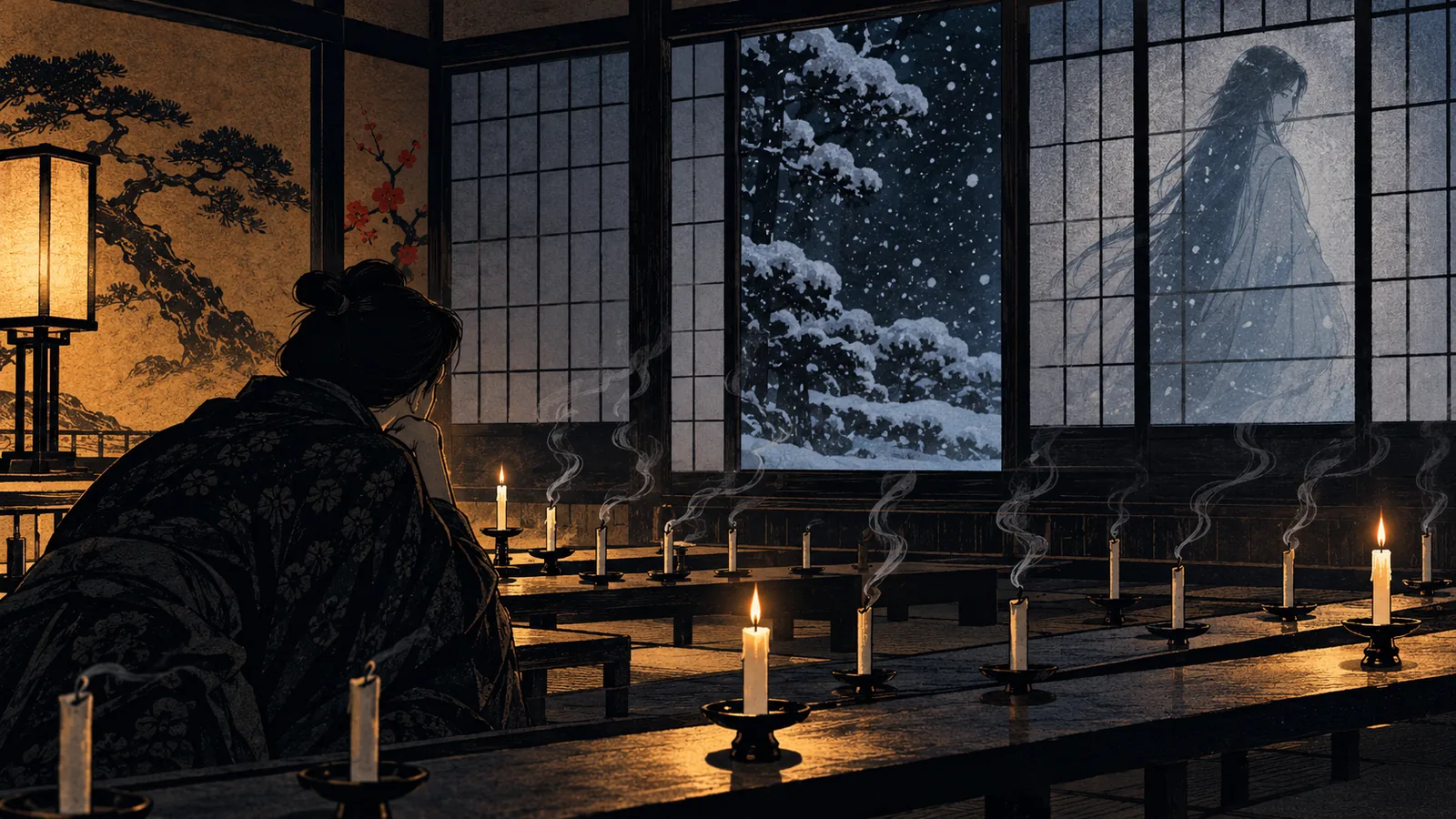
The core answer: Classic Japanese ghost stories—known historically as kaidan (怪談)—offer an ideal Halloween reading tradition because they prioritize haunting psychological suspense, profound grief, and moral consequence over simple violence or physical terror. Preserved across centuries in theatrical kabuki scripts and recorded in English by Lafcadio Hearn in 1904, tales like Yuki-onna and Hoichi the Earless explore what happens when human vows are broken under the gaze of the supernatural.
For those seeking an evening of literature beside warm lamplight, here are four timeless Japanese ghost stories that resonate deeply in autumn.
1. Yuki-onna: The Snow Woman and the Broken Promise
Recorded by Lafcadio Hearn from folklore in Musashi Province, Yuki-onna tells of a young woodcutter named Minokichi trapped in a blizzard inside a solitary river hut.
The Encounter
A woman of supernatural beauty with pale white skin and freezing breath appears, killing Minokichi's elderly mentor but sparing Minokichi because of his youth. Her sole condition: "You must never speak of what you saw tonight to any living soul, not even your mother. If you speak, I will kill you."
The Revelation
Years later, Minokichi marries an exquisite stranger named O-Yuki, with whom he lives harmoniously and raises ten children. One stormy autumn night, gazing at his wife sewing by the hearth, Minokichi inadvertently confesses how much her profile resembles the spectral woman he saw long ago. Instantly, O-Yuki transforms into mist, declaring: "You broke your vow. Had we not these children, I would take your life now. Care for them well, or I shall return." She melts into the rafters, leaving only winter air behind.
2. Hoichi the Earless: The Blind Musician of Dan-no-ura
Set near the coastal waters of Shimonoseki, this legend captures the tragedy of the Heike samurai clan defeated in 1185.
The Midnight Concerts
Hoichi, a blind lute (biwa) player residing at a local Buddhist temple, is secretly led each night to a shadowy noble pavilion to recite the tragic fall of the Heike warriors. Enchanted by his music, the weeping audience reveals itself as the restless ghosts of drowned samurai.
The Missing Characters
Realizing that the vengeful spirits will soon drag Hoichi to his death beneath the waves, the temple's abbot paints the sacred Heart Sutra across Hoichi's entire body to render him invisible to spirits. Tragically, the priest forgets to brush the holy text onto Hoichi's ears. When the spectral samurai arrives and finds only two detached ears floating in the courtyard, he tears them away as proof of his visit, leaving Hoichi alive but permanently scarred.
3. The Three Great Kaidan Legends of Japan
Beyond Hearn's compilations, classical Japanese theater developed three foundational ghost narratives:
| Tale Title | Historical Setting | Central Motif | Emotional Core |
|---|---|---|---|
| Yotsuya Kaidan (Oiwa) | Edo Period, Tokyo | Vengeance of a betrayed wife | The destructive guilt of an ambitious spouse |
| Bancho Sarayashiki (Okiku) | Himeji Castle | The counting of broken porcelain plates | The grief of a defenseless servant framed by power |
| Botan Doro (The Peony Lantern) | Asakusa, Tokyo | A lover who visits from the grave | The fatal passion that blurs life and death |
4. The Moral Mirror of Japanese Folklore
Western horror frequently casts ghosts as foreign invaders into ordinary life. In Japanese kaidan, ghosts are born from within: they are the unfinished business of human hearts, the physical manifestation of promises unkept, and the natural consequence of cruelty.
Yokaizen is an AI Life RPG set in this world of Japanese yokai: anime companions who call you by your chosen name, and webtoon stories that change with what you actually do.
Frequently Asked Questions
Q. Why do Japanese ghosts often have no feet in woodblock prints?
A. Classical ukiyo-e artists (influenced by 18th-century master Maruyama Okyo) depicted spirits (yurei) with trailing robes that fade into mist. The absence of visible feet symbolized that the soul was detached from the earth, suspended between realms by lingering obsession (nen).
Q. Was Lafcadio Hearn a Japanese citizen?
A. Yes. Patrick Lafcadio Hearn (1850–1904) moved to Japan in 1890, fell in love with its folklore, married Koizumi Setsu, and took the Japanese name Koizumi Yakumo, becoming one of the most celebrated cultural bridge-builders of the Meiji era.
Q. Are kaidan tales read during the summer or autumn in Japan?
A. Traditionally, ghost storytelling peaked during the summer Buddhist festival of Obon (August), when the chilling sensation of fear was believed to cool the summer heat. In modern times, they are widely embraced during autumn alongside Halloween.
Sources
- https://en.wikipedia.org/wiki/Kwaidan:_Stories_and_Studies_of_Strange_Things (Lafcadio Hearn, Kwaidan, 1904)
- https://en.wikipedia.org/wiki/Lafcadio_Hearn (Lafcadio Hearn / Koizumi Yakumo, 1850–1904)